Aotearoa New Zealand

Bring marine life back
to hard coastlines

Restoring Sealife aims to bring together mana whenua, councils, ports, scientists and community groups to help transform seawalls, pilings and other hard coastal infrastructure into thriving intertidal habitat for marine life. We aim to make public learning and community participation part of how we develop and monitor each project.

Early stage · Working toward a first demonstration project
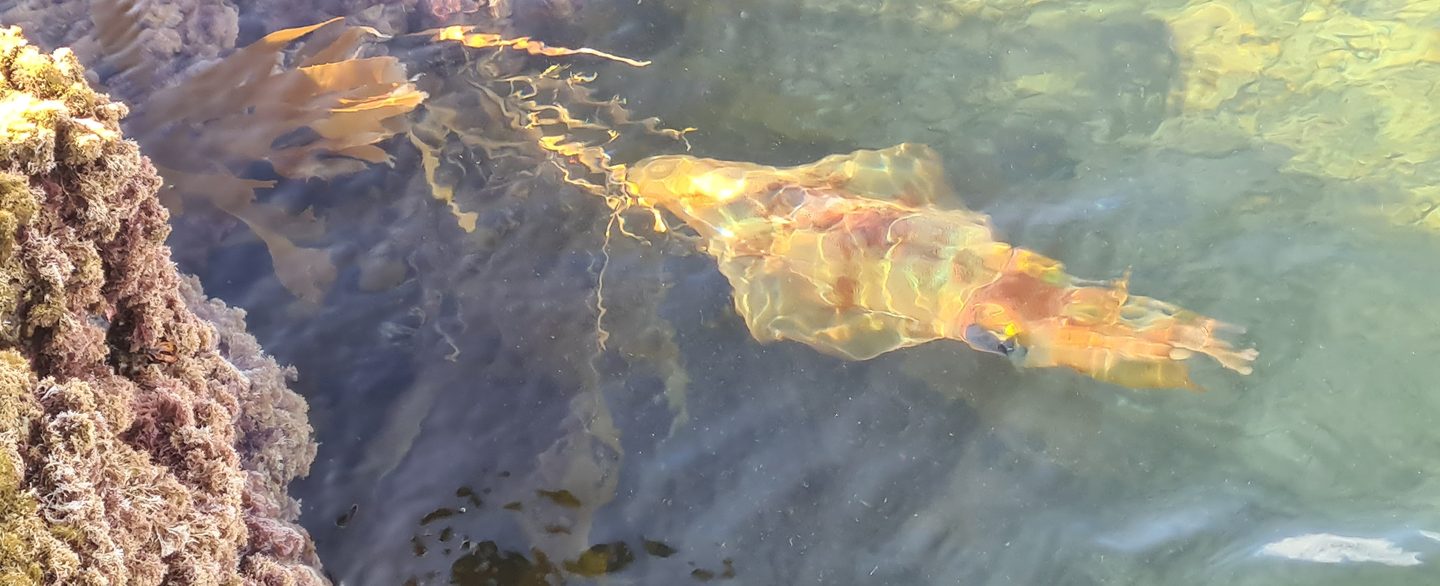
A golden-orange southern reef squid swimming through clear water beside golden-brown kelp and a seaweed-covered rock at Long Bay, Auckland
Southern reef squid (Sepioteuthis australis) at Long Bay, Auckland, 29 September 2026. View the iNaturalist observation · Photo: Craig Barker, CC BY-NC
The Problem

Concrete coastlines,
depleted waters

Across Aotearoa, harbours, marinas and urban shores are increasingly edged with seawalls, pilings and breakwaters. These smooth concrete and steel surfaces give marine life little to attach to, shelter in or feed from. Where rocky shores once supported rich intertidal life, engineered edges often hold very little.

Intertidal life is also under pressure from sedimentation, overharvesting, pollution and a changing climate. Communities around the country are noticing, and many are organising to protect what remains.

The Hauraki Gulf / Tīkapa Moana shows both the pressure and the response. Its shellfish beds and seagrass meadows have declined, with overfishing, sedimentation and climate change all contributing. The Hauraki Gulf Forum's State of our Gulf 2026 report, the first published since the Marine Protection Act 2025, finds the Gulf improving in places but still under significant pressure from sedimentation, plastic pollution and overfishing.

The Hauraki Gulf / Tīkapa Moana Marine Protection Act 2025, which came into force on 25 October 2025, establishes 19 new protected areas: two marine reserve extensions, 12 high protection areas and five seafloor protection areas. DOC's figure describes marine reserves and high protection areas growing from 0.3% to 5.9% of the Gulf's area; this does not describe all 19 areas combined, and it is not a site-specific consent determination for any Restoring Sealife activity.
Act No. 54
Royal assent on 10 October 2025; came into force on 25 October 2025

New Zealand legislation

19 areas
2 marine reserve extensions, 12 high protection areas, and 5 seafloor protection areas established by the 2025 Act

DOC marine protections

5.9%
marine reserve and high protection area coverage in the Gulf, up from 0.3% (excludes the Cable Protection Zone)

DOC marine protections

Our Approach

Habitat that bolts on

Restoring Sealife focuses on retrofitting modular habitat onto existing coastal infrastructure and making the monitoring legible to the public. Third-party precedent work in New Zealand has used different approaches. Tauranga used Living Seawall Boulder products developed by Reef Design Lab and the Sydney Institute of Marine Science. Auckland Council's trial at Westhaven Marina used specially designed, 3D-printed modules. Projects in Wellington, Lower Hutt and Lyttelton have used other concrete units, tiles, pools and textured wall surfaces (see the tables below).

We want each installation to be a place for public learning as well as habitat enhancement. That means planning interpretation, community participation and scientific monitoring together, so people can understand what is being tested and follow what is learned.

🪸

Science-backed design

Habitat surfaces can add rock-pool texture and shelter to otherwise smooth coastal structures, with monitoring used to test what returns.

🔩

Retrofit, don't rebuild

Habitat modules attach to existing seawalls, pilings and breakwaters rather than requiring new structures to be built. Suitability, attachment method, loads, materials and any required approvals depend on the specific site and design.

🗺️

New Zealand precedents

Habitat units, tiles and pools have been reported on coastal structures in Wellington, Lower Hutt, Lyttelton, Tauranga and Auckland (see the tables below). Delivered by others; we are learning from them.

❓

What is still unclear

Reported results vary: some sites describe surveys against adjacent or control habitats, others only early observations, and several report no numerical ecological results that we could find. Public monitoring is part of what Restoring Sealife aims to help with.

Evidence Base

What public sources currently show

Public sources report marine habitat enhancements on coastal structures at several New Zealand sites. This table lists the projects we have found. There may be others. The sites use different methods, so the rows are not comparable.

Publicly reported New Zealand marine habitat enhancements on coastal structures
Project and lead organisation What was installed (as reported) When What public sources report Sources
Cobham Drive, WellingtonWellington City Council 40 ecological tiles with a woven (kete) pattern and 20 drill-cored rock pools, in a 430 m rock revetment Project dates 2020-2022; tiles reported in place by April 2022 Greater Wellington Regional Council and Victoria University of Wellington are described as monitoring the work long-term. No results found in the sources we reviewed.
Lyttelton Port, tide poolsLyttelton Port Company 4 precast concrete tide pools in the cruise berth revetment November 2023 Boffa Miskell, the project's designer and monitor, reports six-monthly surveys for two years against adjacent boulders: diversity comparable within six months, about twice as many taxa as on adjacent rock surfaces after two years, distinct communities, and some non-native species. This is the designer's own report, not an independent review.
Tauranga HarbourTauranga City Council 100 precast concrete habitat modules in a rock-revetment seawall 2024 The February 2025 University of Waikato update reports monitoring by the University of Waikato and Toi Ohomai since May 2024, and lists glass shrimp, cushion stars, bryozoans, sea squirts and triplefin fish.
Te Ara Tupua, Ngā Ūranga to Pito-One, WellingtonNZ Transport Agency, delivered by the Te Ara Tupua Alliance Tide pools, armour units, reef units and offshore rock islands. The project's designer reports more than 200 tide pools and more than 1,800 eco-enhanced armour units; NZTA reports 56 concrete reef units. Two offshore rock islands were also built. Reef units installed May to July 2024; path opened 16 May 2026 Boffa Miskell reports an assessment up to 24 months after installation, against control and reference sites; the page we read gives no numerical biodiversity results. NZTA says a monitoring programme is established.
Lyttelton Port, ECOncrete unitsLyttelton Port Company Over 200 concrete "Coastalock" habitat units, reported installed by the port in cluster patterns on a new reclamation seawall Trial units from February; port updates dated 1 April and June 2026 The port reports early algae growth and describes initial results as positive. No monitoring programme is described in the updates we reviewed.
Tupua Horo Nuku, Eastern Bays, Lower HuttHutt City Council (design and consenting); built by the Te Ara Tupua Alliance A 4.4 km shared path and seawall along Marine Drive, with "textured seawall surfaces and purpose-built tidal pools" (the council's words) Built in stages; first section opened November 2023; project opened 18 April 2026 The council page gives no counts and reports no monitoring. A March 2026 Cawthron Institute review quotes a contributor account that monitoring has begun, data are not yet available, and early colonisation has been observed anecdotally.
Westhaven Marina, AucklandAuckland Council 12 specially designed 3D-printed concrete modules, shaped on limpets and barnacles Likely second half of 2025: the council says its August survey was a year after installation; no exact date given Auckland Council reports that a survey by the project team found all 12 intact and heavily colonised by seaweeds, oysters, barnacles, sponges, crabs and cushion stars. No quantitative colonisation results or survey method are given in the article.

Figures and results are as stated in the cited sources, reviewed on 4 November 2026. Where a cell says nothing was reported, it means not described in the sources we reviewed. Results come from owners, designers and monitoring teams, and the sites differ, so this table does not compare them.

Standalone reefs on the seabed

Some New Zealand projects have placed reef structures directly on the seabed rather than on coastal structures. This table lists those we have found. There may be others. The projects differ in method, setting and purpose, so the rows are not comparable.

Publicly reported New Zealand standalone reef projects on the seabed
Project and lead organisation What was installed (as reported) When What public sources report Sources
Long Bay-Okura Marine Reserve, AucklandAuckland University of Technology 24 concrete Reef Ball units (an American proprietary design) in two groups of 12, about 500 m offshore in a marine reserve Consents approved by April 2001 The project team reported colonisation within days, juvenile fish after about a year, and about 10 cm of sediment scour. The last formal monitoring report we found is from 2004; a 2023 diver's account was informal. Later surveys cited by Cawthron found Mediterranean fanworm on the units.
Ōpōtiki Community Reef, Bay of PlentyŌpōtiki Community REAF Trust Concrete reef modules under 50 kg each, placed in a charted area off Hikuwai Beach From 2007 The trust's own account in the Cawthron review says the 10-year resource consent has expired, with about 10 of about 800 possible sites used, and reports positive informal comments. A COVID-era dive survey noted modules had likely subsided into the seabed and found no invasive species. Single source.
Napier reefs, Hawke's BayNapier Port Two reefs made from limestone boulders of a dismantled revetment wall, moved as part of the port's wharf resource consent 2021 Napier Port reports juvenile kōura and fish including blue cod, john dory, kingfish and snapper. Mana whenua requested a two-year rāhui at one reef in February 2023; the NZ Herald reported in July 2023 that it was placed. We did not confirm its current status.
Bluff Harbour pilot reef, SouthlandSea Nest Ltd Concrete "Kokoru" habitat modules on the seabed near a consented marine farm; reported as six modules (Otago Daily Times) and eight (company entry in the Cawthron review) Deployed May 2024 The company's own figures: taxa rising from 4 after two weeks to about 23 after five months (Otago Daily Times), and species from 5 at deployment to 30 at week 53, against 7 in the benthic baseline (Cawthron review). No formal monitoring report was found on its site.
"Peara" reefs, Tauranga HarbourDeep Dive Division Nine reefs at 13 m depth, six manufactured and three built by 3D concrete printing, using natural fibres and marine-grade concrete Early May 2025 (press reports) Press coverage lists the University of Waikato, local iwi and others as partners, with an initial trial of 24 to 36 months. The project leader is quoted saying effects were visible quickly; we found no formal monitoring results.

Figures and results are as stated in the cited sources, reviewed on 4 November 2026. Where a cell says no results were found, it means none were described in the sources we reviewed. Results come from owners, designers and project teams, and the projects differ, so this table does not compare them.

The Cawthron review also reports New Zealand reef projects that were later removed or abandoned, including a surf reef at Mount Maunganui, an artificial reef at Ōpunake, and small research plots in Tauranga Harbour. Regulatory approval, cost and long-term monitoring are recurring themes in that review.

These projects were delivered by others. They are listed as New Zealand precedents. Restoring Sealife was not involved in delivering any of them, and listing them does not imply a relationship with their owners, designers or teams.

How It Works

From bare concrete to living reef

This is our intended pathway. A project would proceed only when the relevant assessments, relationships, permissions and resources are in place.

Explore

Start with mana whenua, then bring councils, marine scientists and site owners together to understand the opportunity and choose priority sites where added habitat can do the most ecological good.

Assess

Seek site-specific ecological and engineering advice, consider alternatives, and decide whether enhancement is appropriate.

Co-design

Develop a proposal with the people involved: the habitat approach, maintenance responsibilities and monitoring plan.

Approve

Establish the relevant permissions, consent requirements, biosecurity measures, funding and installation arrangements.

Install

If the project can proceed, use suitably qualified people to deliver the agreed design safely.

Monitor and share

Develop a monitoring plan with research partners and mana whenua, including appropriate opportunities for citizen science. Track what changes, explain what the findings can and cannot tell us, and share results under data arrangements agreed with mana whenua for the site.

Explore the citizen science approach →
Citizen science & public learning

Find out together what comes back

A habitat installation is also an opportunity to learn. We're designing a citizen science approach that would let students, local residents and community groups help document marine life alongside researchers.

For a first pilot, we envisage individually identified habitat modules, structured observations and photographs, and possible links to iNaturalist. People could follow a particular module over time and contribute to a shared picture of what lives there and how it changes.

Observe

Participants would learn to recognise local marine life and record what they find. Clear guidance would help participants take useful photographs and make observations at agreed locations, where access is safe and appropriate.

Build a picture over time

Repeat observations could help document seasonal changes and the arrival of different species. Research partners would help shape the questions, survey methods and checks needed to make those records useful alongside planned ecological monitoring.

Share what we learn

We want the learning to be visible beyond the research team: through interpretation at the site, activities for schools and community groups, and accessible updates about findings—including unexpected results and things that remain uncertain.

Photographs and species sightings can tell us what has been observed. Assessing whether an installation improves habitat requires a monitoring design that can test that question.

Still in development

No pilot site has been selected. We would develop the monitoring and participation approach with mana whenua, site owners, research partners and educators. Data arrangements, including what can be shared publicly, would be agreed from the outset. There is nothing to sign up to yet.

We're also testing a phone prototype in public.

Follow the build diary →

Help shape the approach

We'd welcome conversations with marine researchers, educators, schools, citizen scientists and community groups interested in helping design a useful, accessible citizen science approach.

Talk to us about citizen science →
Who we want to bring together

Different roles, common ground

Restoring habitat on built coastlines takes people who don't usually sit at the same table. Our aim is to bring them together and help keep the work moving.

🌿

Mana whenua

Mana whenua come first. We seek engagement with iwi and hapū at the design stage of any project, before sites or products are chosen. Monitoring data and mātauranga shared through a project stay under the control of those who hold them, under agreements made at the start.

Get in touch →
🏛️

Councils and asset owners

Seawalls, wharves and breakwaters are already maintained and renewed. We aim to help councils and asset owners add habitat as part of that work, and to coordinate the specialists needed to do it.

Get in touch →
⚓

Ports and marinas

Ports and marinas manage some of the most engineered shorelines in the country. A habitat retrofit gives them a visible, monitored contribution to marine life on infrastructure they already own.

Get in touch →
🔬

Scientists and researchers

We aim to connect each site with research partners, so monitoring is designed properly from the start and results are shared in a form the public can follow.

Get in touch →
🤝

Community groups

Local groups already watch, protect and monitor their coastlines. We want to connect that knowledge and energy with habitat projects, help shape useful questions, and create opportunities to contribute observations and learn together.

Get in touch →
💚

Funders and sponsors

Every project needs support for habitat modules, installation and monitoring. We can talk through what a pilot would involve and where support would go.

Get in touch →
Across Aotearoa

Connecting groups across the country

People caring for coastlines are working in parallel all over Aotearoa: rockpool protectors, marine reserve volunteers, dive clubs, schools, researchers and hapū monitoring teams. Many are working through the same questions without knowing about each other.

Restoring Sealife aims to help connect them: sharing what's working, linking local observations with research, and making it easier for each new site to learn from the ones before it. Local knowledge can help shape the questions we ask and the changes we watch for.

Shared learning

We aim to record and share what works, what does not, and what remains uncertain, so each project can build on earlier experience.

Compatible monitoring

Work towards compatible monitoring methods where appropriate, while allowing for different sites, research questions and locally agreed data arrangements.

Local capability

We aim to build paid local roles in monitoring and delivery into projects where funding allows.

Part of a group working on your coast? We'd like to hear what you're doing and what you've learned.

Tell us about your group
Projects

Precedent and pipeline

Restoring Sealife is at feasibility stage. We are working toward a first pilot and will name pilot sites publicly once mana whenua and site owners have been engaged.

Precedent, delivered by others

Tauranga Harbour

100 habitat modules installed in Tauranga Harbour, with the University of Waikato and Toi Ohomai monitoring since May 2024. Restoring Sealife was not involved in delivering this project; we are learning from it.

Precedent, delivered by others

Westhaven Marina, Auckland

Auckland Council has trialled 12 specially designed, 3D-printed habitat modules on the Westhaven Marina seawall. The council reports that a survey by the project team found all 12 intact and colonised by seaweeds, oysters, barnacles and sponges. Restoring Sealife was not involved; we are learning from it.

Feasibility

First pilot

We are assessing options for a first pilot, starting small so results can be monitored properly before anything grows. Sites will be chosen with mana whenua, site owners and research partners. A promising starting point includes: an asset owner willing to explore the idea; early engagement with mana whenua and local communities; suitable ecological and physical conditions; safe access for installation, maintenance and monitoring; and a realistic pathway for permissions, resourcing and long-term care.

Suggest a site
About

Why this work exists

Aotearoa's coasts are increasingly engineered, but hard infrastructure does not have to stay ecologically empty. Restoring Sealife exists to help coastal partners retrofit habitat into existing structures, translate monitoring into public understanding, and build restoration projects that are locally grounded, evidence-led, and transparent about what is still being tested.

Our vision: a New Zealand coastline where built structures support marine life rather than displace it.

Established organisations already restore dunes, mussel reefs, seagrass, kelp and marine reserves. Restoring Sealife adds to that work by focusing on seawalls and other hard infrastructure in the intertidal zone, and by connecting the people already working on these coastlines.

People

Who's behind this

Restoring Sealife is run by a small team of marine conservation volunteers. We're keeping this page simple while the team is being assembled — get in touch if you'd like to know more.

Get in touch →
On the coast

Field notes

A small, occasional note on what is happening on Aotearoa's coast, with sources. Last updated 4 November 2026.

Rockpool closure in force across three Hauraki Gulf areas

In force since 12 March 2026 (two years)

What happened

The Minister for Oceans and Fisheries closed three areas of the northern Hauraki Gulf: Ōmaha Bay, Kawau Bay and the Whangaparāoa Peninsula, each out to 200 m offshore. Ngāti Manuhiri Settlement Trust requested it, and it gives legal backing to their rāhui. Taking seaweed and invertebrates is prohibited. Kina can still be taken within recreational limits.

Why it matters for the coast

Rockpools and shore invertebrates are part of the intertidal habitat along this coastline. The closure applies for two years.

Sources: Beehive release “Rockpool closures to protect marine life” (15 Feb 2026); MPI page “Proposed temporary fisheries closure in the Hauraki Gulf” (updated 15 Feb 2026)

Source status: in force. Verified 15 Oct 2026.

Auckland, Coromandel and Waiheke intertidal closure now in force

In force since 1 November 2026

What happened

A Fisheries notice (MPI 2043) came into force on 1 November 2026. It covers the shore from the mean high-water springs mark out to a point two metres deep: the east coast from Cape Rodney to Houmanga Point, the west coast from the mouth of the Ōkiritoto Stream to Port Waikato, and all of Waiheke. Recreational fishers may not take or possess invertebrates there, apart from a listed set of exceptions, including pāua, pipi, kina and tuatua. Customary fishing is not restricted.

A release from the Minister for Oceans and Fisheries on 2 November 2026 says that from 26 November 2026 Fishery Officers will be able to issue infringement notices carrying a $250 penalty, and that more serious offences can still be prosecuted. It says Fisheries New Zealand is placing signs in the affected areas and running a six-week awareness campaign.

Why it matters for the coast

The rule applies to the intertidal zone where shore invertebrates live. Mussels are not on the exception list. Rules and limits for this area have changed recently and may change again, so MPI’s Auckland and Kermadec area fishing rules page is the place to check the current position.

Sources: MPI page “Review of measures for shore-based shellfish harvesting in the Auckland-Coromandel area” (decisions published 8 Oct 2026); Gazette notice MPI 2043, dated 28 Sep 2026; Beehive release from the Minister for Oceans and Fisheries (2 Nov 2026); MPI page “Auckland and Kermadec area fishing rules” (last reviewed 1 Nov 2026)

Source status: closure in force since 1 November 2026; infringement notices announced to start 26 November 2026. Verified 4 Nov 2026.

State of our Gulf 2026 rates the Hauraki Gulf “under pressure”

Hauraki Gulf Forum, July 2026

What happened

The Hauraki Gulf Forum's State of our Gulf 2026 report gives the Gulf an overall rating of “under pressure”. It mentions 19 new marine protected areas, the inner Gulf kōura closure from April 2025, and the Firth of Thames being declared degraded in 2025. It reports 2% of monitored estuary sites in excellent condition, the spread of Caulerpa, marine heatwaves, and three iwi asking for rāhui extensions.

Why it matters for the coast

It is a recent, published overview of how the Gulf's marine environment is doing, and the setting for the intertidal closures above.

Source: Knowledge Auckland (Auckland Council research site), publication page for State of our Gulf 2026. Findings are those shown on that page; the full report was not opened.

Source status: published. Verified 15 Oct 2026.

Auckland Council reports growth on 3D-printed habitat modules at Westhaven Marina

Auckland Council, 2 November 2026

What happened

Auckland Council reports that a survey by the project team, a year after installation, found all 12 specially designed 3D-printed modules on the Westhaven Marina seawall intact despite severe weather and heavy wave action. The council also reports that the modules were colonised by seaweeds, oysters, barnacles, sponges, crabs and cushion stars. The council says growth was faster than is typically seen on a conventional seawall. The article gives no figures or comparison method. The council says it worked with mana whenua.

Why it matters for the coast

The council’s account is that the existing seawall, built in the 1930s, offered limited habitat because of tidal action, pollution and a smooth concrete surface. This council account describes observations from a single trial. It does not establish what would happen elsewhere.

Sources: OurAuckland, November 2026: “‘Living seawalls’ trial boosts marine life at Westhaven”; OurAuckland, 2024: “3D-printed marine modules to restore marine life and mauri in Te Waitematā”

Source status: published by Auckland Council. Verified 4 Nov 2026 against the council’s pages.

Restoring Sealife had no part in the decisions or projects described above.

Adopt a Seapod

Sponsor habitat, follow what returns

Adoption is not open yet. We are exploring a way for people and organisations to help fund a community-sponsored pilot. If it goes ahead, contributions would go toward seapods (habitat modules), installation, and the monitoring that shows what comes back. Supporters could be recorded in a supporter registry and receive updates as their pod moves from order to installation to first monitoring results. Monitoring updates would be shared in line with data arrangements agreed with mana whenua for the site.

🐚

Adopt a Seapod

Sponsor one seapod. Supporters could be recorded in a supporter registry, under their own name or one they choose, and receive installation and monitoring updates for their pod.

Coming soon
Adopt one seapod
🪸

Adopt a Cluster

Sponsor a cluster of five seapods, intended to form a connected patch of habitat. Registry recognition for a family, group or business would be considered.

Coming soon
Adopt a cluster
🌊

Founding Site Sponsor

Talk to us about supporting a whole installation. Recognition and reporting would be discussed and agreed with you.

Let's talk
Get in touch

Adoption is not open yet. When it opens, a contribution would go toward a pilot installation; it would not be a purchase of a physical product. Pods would be installed on coastal infrastructure and stay in the sea where they belong.

Your questions

Questions about getting involved

We're working towards a first demonstration project. Here's what the idea involves, what is still being developed and how you can help shape it.

What is Restoring Sealife, and what stage is it at?

Restoring Sealife is an early-stage initiative exploring how to add habitat to existing seawalls and other hard coastal structures, with scientific monitoring and public learning planned alongside it. No pilot site has been selected and we have not delivered an installation yet. Our role is to bring the right people together and help turn an idea into a practical, carefully assessed project.

What are habitat modules or “seapods”?

They are features designed to add texture, crevices, pools or shelter to coastal structures. This site uses “seapod” as a simple term for a habitat module. Habitat modules are one kind of what is often called artificial aquatic habitat (AAH). Different projects use different designs and materials; a product and attachment method would be chosen to fit the particular site. Restoring Sealife does not manufacture or sell the modules.

Is this the same as Living Seawalls, or one of the projects listed here?

No. Living Seawalls is one of the initiatives we are learning from. The New Zealand projects in our evidence tables were delivered by other organisations, and Restoring Sealife was not involved in delivering them. Listing a project or linking to an organisation does not imply a partnership or endorsement. Explore the evidence base.

Does adding habitat actually help marine life?

Some projects report colonisation and differences in the marine communities using enhanced structures. However, designs, locations and monitoring methods differ, and some published accounts give only early observations. Results elsewhere cannot guarantee an outcome at a new site. A pilot would need a monitoring plan that can test its ecological aims, rather than treating the presence of a few species as proof of success. See what the public sources report.

Why add habitat to built structures rather than restore natural shores?

Our focus is infrastructure that already exists. We want to explore whether those hard edges can provide better habitat while continuing to serve their intended purpose. This complements efforts to protect and restore natural shores. Habitat enhancement is not a substitute for addressing pollution, sedimentation, harvesting pressure or other causes of marine decline, and it should not be presented as a reason to damage existing habitat.

How would a pilot site be chosen, and can I suggest one?

Yes—suggestions are welcome. A site would need early engagement with mana whenua and the asset owner, ecological and engineering assessment, appropriate access, a route through the necessary permissions, and resources for installation, monitoring and ongoing care. We would also consider whether enhancement is appropriate at all. Suggesting a location does not mean it will become a project. Tell us about a possible site.

How would mana whenua be involved?

We seek engagement with mana whenua before sites or products are chosen. The aim is to shape a proposal together from the outset, including local priorities, design, monitoring and interpretation. Arrangements for data and any mātauranga shared through a project would be agreed with those who hold them, including what can be made public. There is no single approach that can simply be applied to every place.

Could modules damage a structure or have unwanted ecological effects?

A proposal would need to assess those possibilities before installation. The assessment would consider attachment and structural loads, materials, existing habitat, biosecurity, access and maintenance. The monitoring plan would need to consider unwanted outcomes as well as intended benefits. Adding habitat should not be assumed appropriate simply because a seawall is available.

How would you know whether a pilot is successful?

We would agree the questions and measures with research partners and mana whenua before installation. Depending on the site, this could include baseline surveys, repeat observations and appropriate comparison areas. We want to understand what changes over time and what the evidence can reasonably attribute to the installation. Ecological results and participation or education outcomes would be reported separately, with limitations explained.

Can schools, community groups and people without science training take part?

That is part of the approach we are designing. Potential activities include guided observations, photographs and species records, supported by clear methods and appropriate supervision. Activities would depend on the site, safe access and the monitoring plan. There is no pilot participation programme open yet, but we welcome educators, researchers and community members who would like to help shape it. Read about citizen science or get in touch.

Will observations be on iNaturalist or available to everyone?

Possible links to iNaturalist are being explored, alongside individual module identifiers and structured observations. No integration or shared project database is operating yet. We aim to make findings accessible, but what data can be shared, where it is held and how records are checked would be agreed with mana whenua and research partners. Some information may need restricted access.

What would a project cost, and who would look after it?

There is no standard pilot price yet. A budget would need to cover assessment, design, permissions, modules, installation, interpretation, monitoring and ongoing care. Responsibilities for inspection, maintenance and responding to damage—including any repair or removal—would need to be agreed with the asset owner and delivery partners before installation. Funding the equipment alone would not fund the whole project.

Can I adopt a seapod or sponsor a project now?

Adoption is not open yet. We are exploring ways for people and organisations to support a pilot, including possible module or site sponsorship. The scope, costs, recognition, updates and terms would need to be settled before contributions are invited. Adoption would not be a purchase of a physical product; a contribution would go toward a pilot installation. Talk to us about supporting a pilot.

How can I help while the pilot is being developed?

We welcome introductions to mana whenua, site owners, researchers, educators, community groups and potential funders. You can suggest a site, share relevant experience or evidence, or help us understand what would make a useful local project. Use the contact form, choose the closest description of your role and tell us about your interest. You can also opt in to occasional project updates.

Reviewed 5 November 2026.

Still have a question? Get in touch →

Get Involved

Help us bring life back
to our coastline

Whether you look after a coastline, own infrastructure on one, study it or simply care about it, we'd like to hear from you. We're also keen to connect with people interested in helping shape citizen science and public learning. Choose what best describes you below, then tell us more in your own words.

No spam. We'll use your details only to reply and, if you tick the box, to send project updates. Privacy

You can also follow our progress on Facebook.